Jul 19, 2026
Before You Hire Another Project Manager: 7 Problems Creative Agencies Should Fix First
A practical decision framework for creative-agency founders considering another project-management hire.

Your studio is busy.
Projects are becoming harder to track. Clients want updates. The team keeps asking where things stand. Senior people are being pulled into project conversations they probably should not be part of.
The obvious answer is simple:
“We need another Project Manager.”
And you might.
A good Project Manager can create enormous value inside a creative studio.
But before you add another coordination role to a 10–20 person team, there is a more uncomfortable question worth asking:
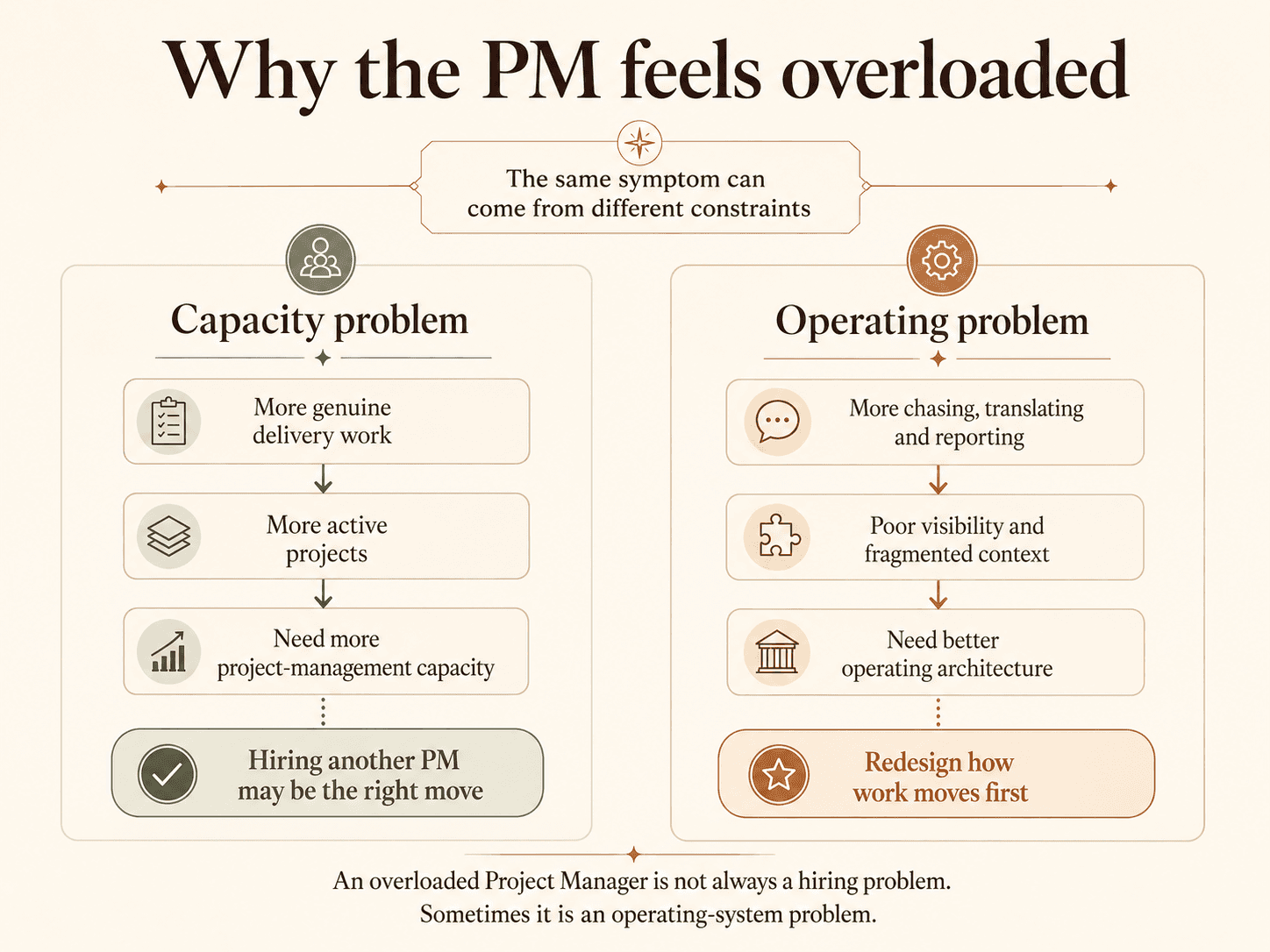
Do you need more project-management capacity, or a better operating system?
Those are two very different problems.
Adding another person can absorb complexity. It does not necessarily remove it.
Before hiring, I would investigate the seven operating constraints below.
1. Project status is created when someone asks for it
Ask your team a simple question:
“Can every relevant person understand the status of an active project without messaging somebody?”
If the answer is no, you probably have a visibility problem.
A familiar loop then appears:
The founder asks for an update.
The Project Manager messages the designer.
The designer explains what happened.
The Project Manager checks the timeline.
The Project Manager rewrites the information.
The client asks for another update two days later.
At that point, the Project Manager has become a human reporting system.
The activity looks like project management. The underlying constraint may be poor operational visibility.
What should be visible without asking?
A strong project system should make the following easy to understand:
Current project stage
Current owner
Next milestone
Important blockers
Pending client decisions
Latest major project decision
Expected next client communication
The goal is not to create another giant dashboard nobody uses.
The goal is to stop reconstructing basic project context every time someone needs visibility.
What I would investigate
How many internal questions each week are requests for information that already exists somewhere?
If the answer is “a lot,” another Project Manager may inherit the information-chasing problem rather than solve it.
2. Project context lives between a few senior people
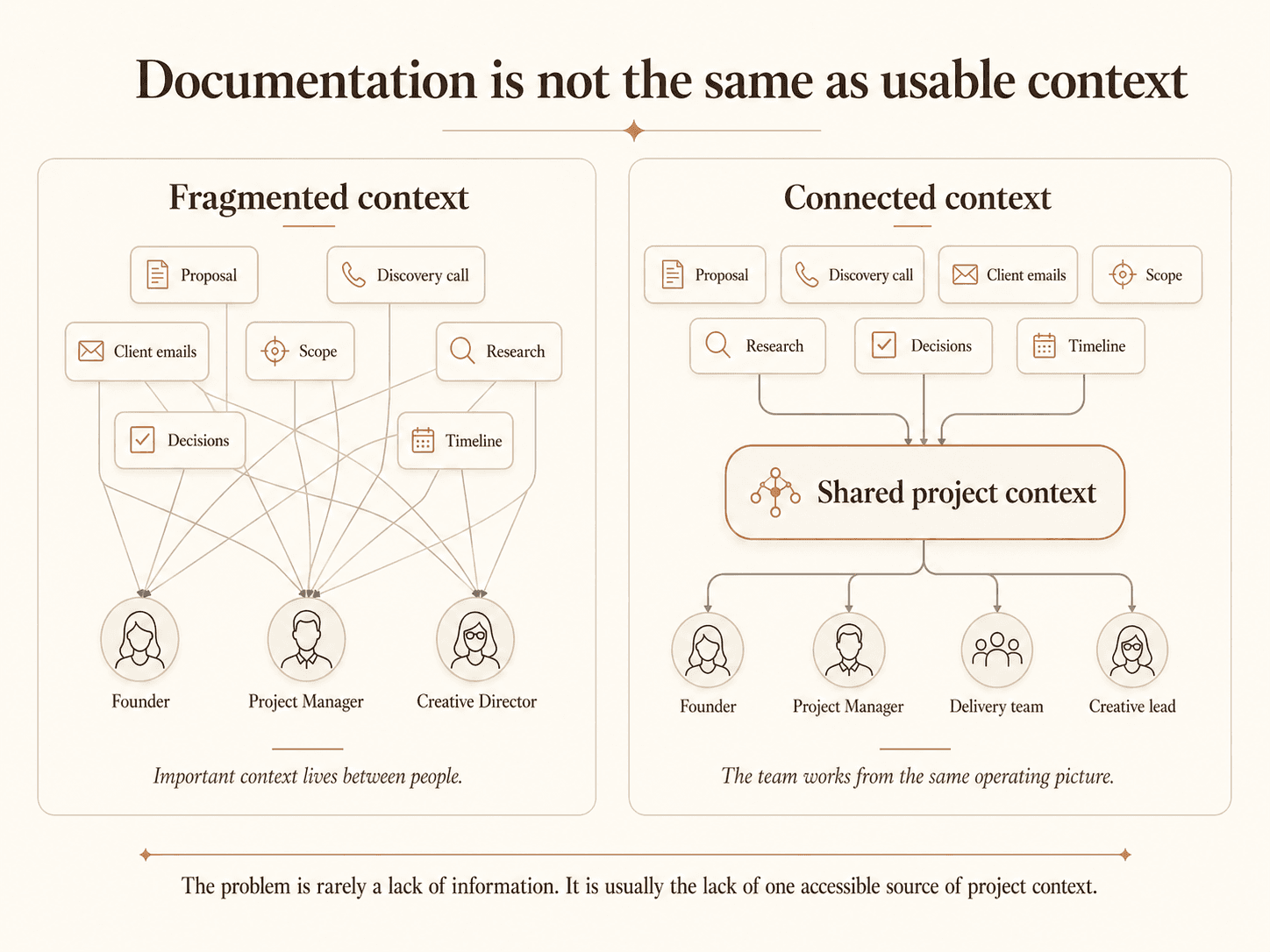
Many creative studios have plenty of documentation.
They still have weak context architecture.
The proposal lives in one tool. The sales-call transcript lives somewhere else. The founder remembers an important client concern. The Creative Director understands the strategic nuance. The Project Manager has the timeline. The delivery team has the tasks.
Everyone has part of the project.
Nobody has the complete operating context.
The result is a human translation layer.
A founder, Project Manager, Creative Director or account lead must repeatedly explain:
What the client really meant
Why a decision was made
What matters most
What changed
What was already rejected
What is inside or outside scope
Project Managers can become extremely busy without actually managing more projects.
They are managing fragmented context.
What I would investigate
Follow one recently signed client from the sales call to the delivery team.
Where was the original context captured?
Who turned it into a usable brief?
What information was lost?
Who had to clarify it later?
Every manual translation is a possible operating constraint.
3. Your Project Managers spend more time chasing than deciding
A strong Project Manager creates leverage through judgment, planning, risk management, communication and delivery leadership.
But look honestly at the role inside your studio.
Coordination work
Chasing updates
Reminding people about deadlines
Asking whether work is finished
Copying information between tools
Preparing status reports
Finding files
Reformatting meeting notes
Following up on internal questions
Project leadership
Identifying delivery risk
Improving planning
Managing scope
Making priority decisions
Protecting the client experience
Improving capacity allocation
The opportunity is not to replace your Project Manager.
It is to stop using your Project Manager as an expensive API between Slack, meetings, your project-management tool and the client.
“Your Project Manager should manage delivery—not manually connect every part of the operating system.”
What I would investigate
For one week, categorize Project Manager activity into two groups:
Judgment
Coordination
If coordination dominates, investigate the system before automatically adding another coordinator.
4. Every project follows a different operating rhythm
Creative work should not become generic.
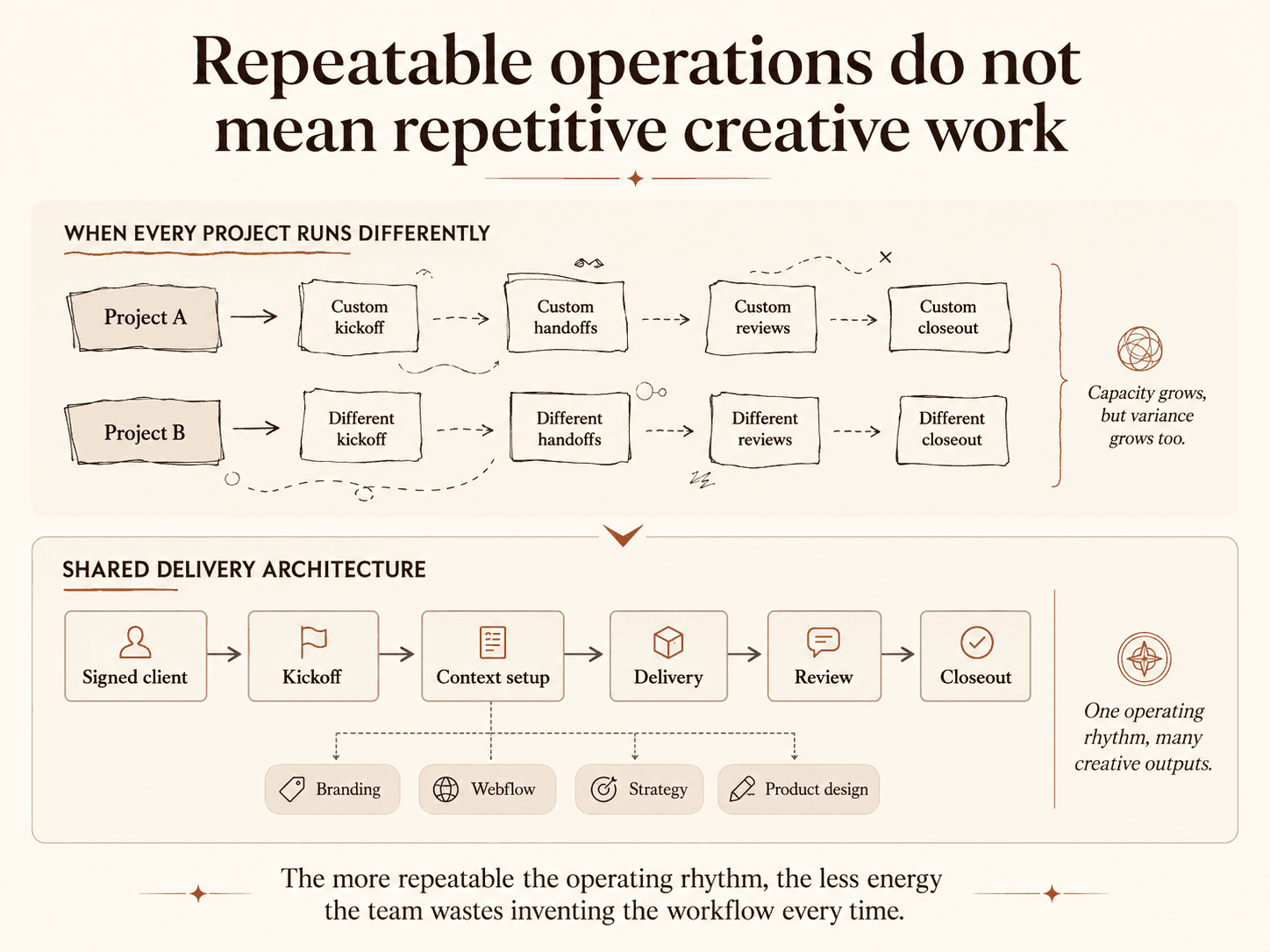
Your operating rhythm can still be repeatable.
A branding project and a Webflow build may produce very different work, but each can still have clear answers to the following questions:
What happens after the client signs?
How is context collected?
Who owns kickoff?
When does internal review happen?
How does feedback enter the project?
How are revisions tracked?
When does senior quality assurance become necessary?
How does the client receive updates?
What does closeout look like?
If every Project Manager has created a separate version of delivery, adding another Project Manager can create another operating style.
You gain capacity, but you also gain variance.
What I would investigate
Ask two Project Managers to explain your client-delivery process separately.
If you receive two completely different answers, you may have individuals managing projects rather than a studio with a designed delivery system.
5. Senior talent is the delivery safety net
One of the clearest warning signs in a growing creative studio is this:
Whenever something becomes unclear, a senior person gets involved.
The founder.
The Creative Director.
The Lead Developer.
The Head of Design.
These people understand the clients, quality bar and history of the studio.
The team naturally learns:
“When in doubt, ask the senior person.”
The problem is not the person.
The problem is that the person has become part of the operating infrastructure.
At TINKR, I describe this as Key-Person Dependency.
Your most talented people slowly become your most expensive routers.
They clarify briefs, review routine work, resolve recurring ambiguity, translate client context and rescue projects.
The studio appears functional because exceptional people are constantly correcting the system.
Founder-led is not the same as founder-routed
Senior involvement can be highly valuable.
A founder or Creative Director should still shape vision, quality, strategy and important client decisions.
The issue begins when normal work cannot move without their routine availability.
What I would investigate
What happens if your founder or most important senior leader disappears for two weeks?
Which projects slow down?
Which decisions stop?
Which questions accumulate?
That often reveals more about the operating system than the process library does.
6. Client communication is reactive
A client asks for an update.
The team responds.
Another client asks.
The Project Manager prepares another update.
The studio feels busy.
The client still feels uncertain.
Reactive client communication creates invisible operating work.
A stronger communication architecture defines:
When clients receive updates
Which information is always included
Where decisions are recorded
How blockers are communicated
How pending client actions are shown
Who owns each communication
What information can be prepared from existing project data
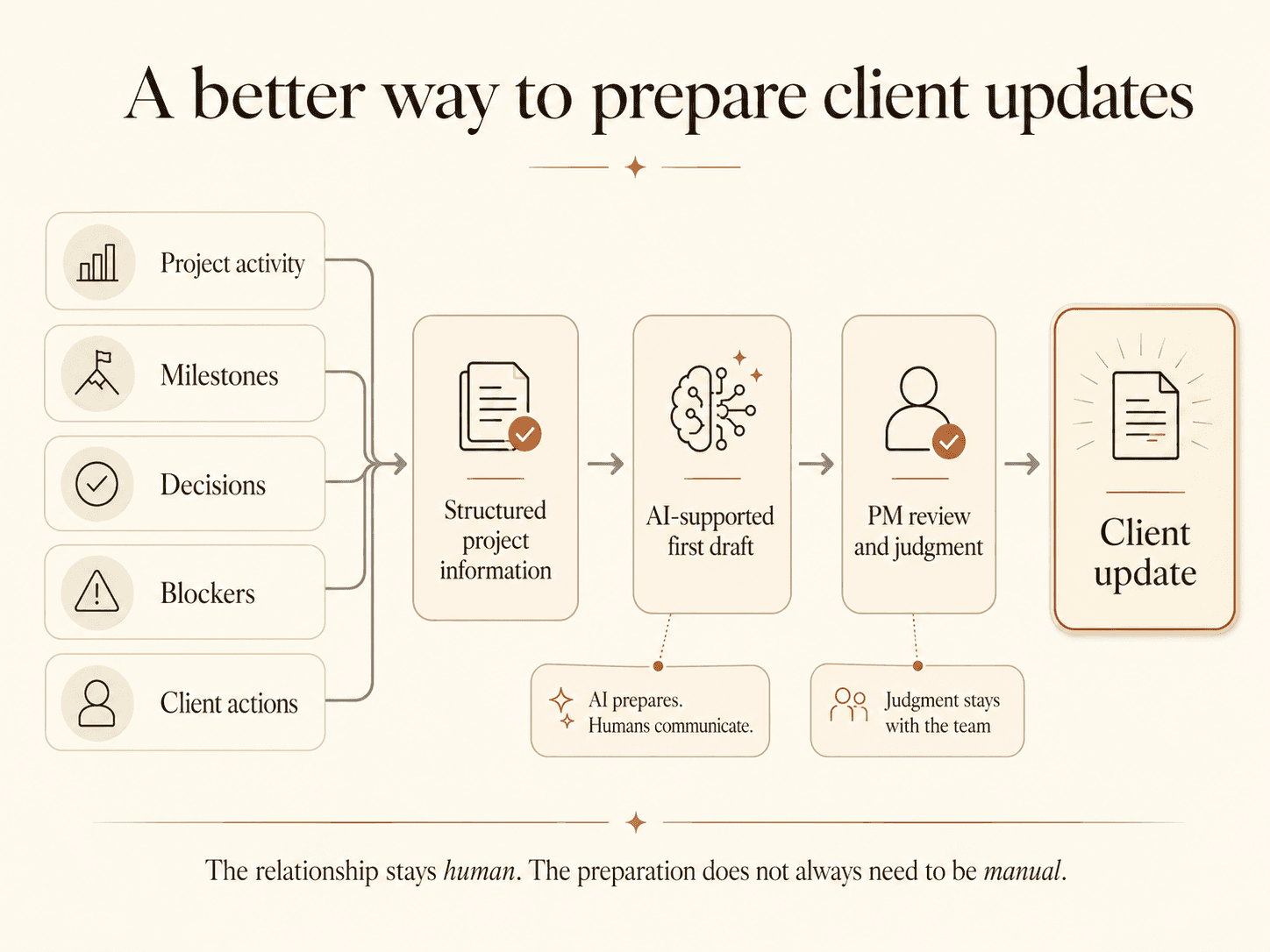
This is also a useful area for carefully designed AI support.
Project information can be synthesized into a first-draft status update.
The Project Manager reviews the communication, adds judgment and sends it.
AI prepares. Humans communicate.
What I would investigate
Count how many client updates are manually created from scratch each month.
Then ask how much of that information already existed inside the project system before somebody rewrote it.
7. Hiring is the default response to capacity pressure
The studio gets busy.
Everyone feels stretched.
The immediate question becomes:
“Who should we hire?”
There should be another question first:
“What is creating the pressure?”
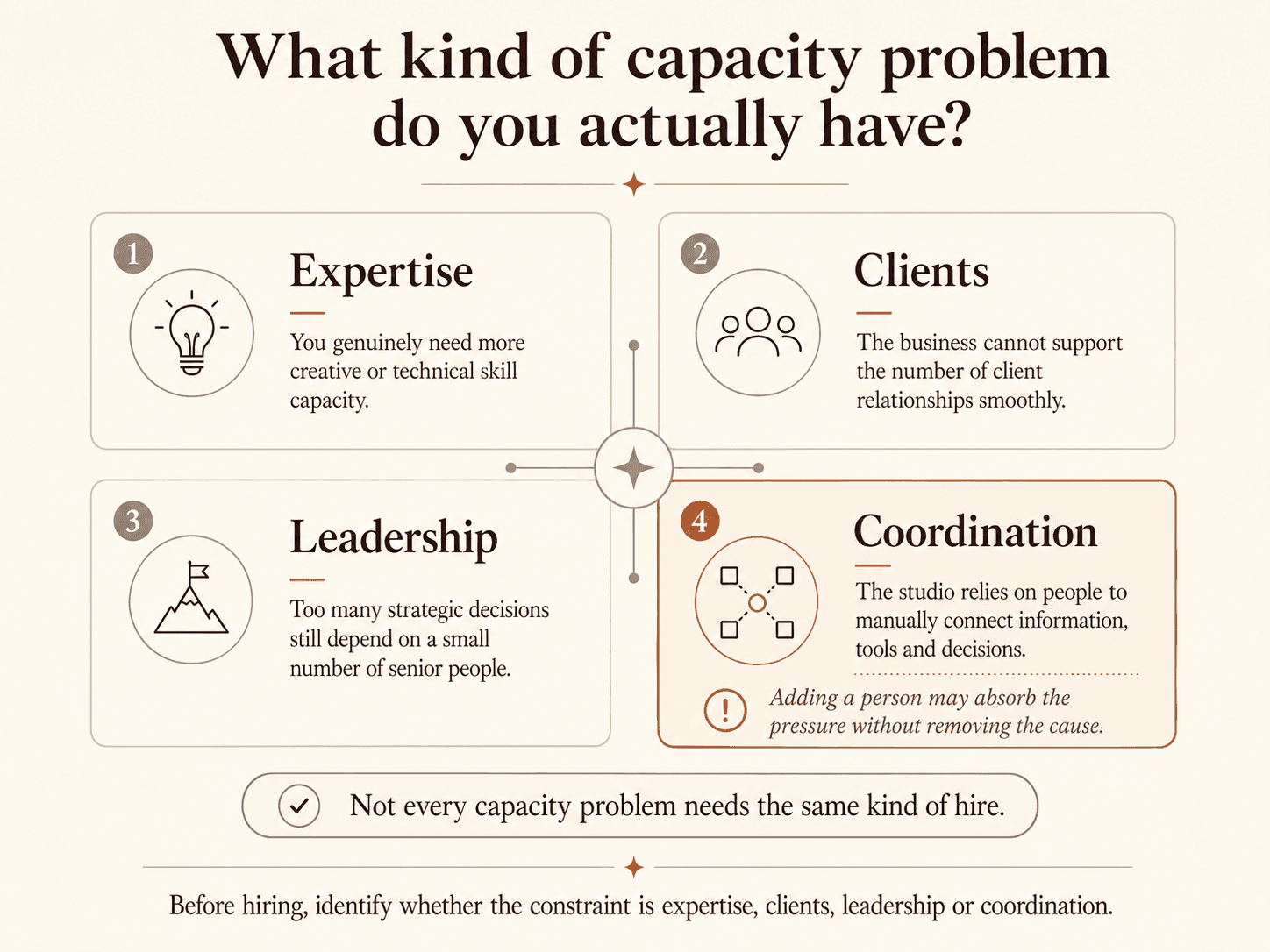
There are at least four possible answers.
Expertise capacity
You genuinely need more design, strategy, development or creative expertise.
Hiring is probably the correct response.
Client capacity
The commercial or account team cannot properly support the number of client relationships.
You may need additional account capacity.
Leadership capacity
A leader is responsible for too many strategic decisions.
You may need another senior person.
Coordination capacity
The current operating model requires people to manually connect information, projects, tools and decisions.
This is the category I would investigate most carefully.
You may still hire the Project Manager.
TINKR is not anti-hiring.
We are against hiring as a substitute for understanding the constraint.
“How capable can the current studio become before it needs to become significantly larger?”
So, should you hire another Project Manager?
Maybe.
A strong Project Manager can be one of the highest-leverage people in a creative studio.
But before hiring, investigate:
Project visibility
Project context
Project Manager coordination load
Delivery consistency
Key-Person Dependency
Client communication
The real source of capacity pressure
The question is not whether another Project Manager can help.
They probably can.
The question is:
“What operating system are you asking them to inherit?”
The worst outcome is hiring a brilliant Project Manager and giving them a broken operating model to manually carry.
Before you hire, identify the real constraint
A new hire should add valuable capability—not become another human connection between fragmented systems, unclear ownership and missing context.
Before opening the role, spend one week observing how project information, decisions, updates and escalations move through the studio.
You may confirm that another Project Manager is exactly what the company needs.
Or you may discover that the existing team is carrying operating work that should not require another person.